IRR (Internal Rate of Return) in relation to Cap Rate, explained by Tim Vi Tran, SIOR, CCIM, top commercial real estate broker in greater San Francisco Bay Area

Understanding Internal Rate of Return (IRR) in Commercial Real Estate: Beyond Cap Rate

By Tim Vi Tran, | Feb 24, 2026 | commercial real estate investment, Industrial properties

Tim Vi Tran, SIOR, CCIM, top CRE broker in Fremont and Silicon Valley, explains IRR (internal rate of return) & cap rate in commercial real estate for investors, buyers, sellers, landlords & tenants.

In our last article, we unpacked cap rate and NOI as the starting point for evaluating commercial real estate investments in Fremont, Silicon Valley, and the greater Bay Area. Cap rate gives you a snapshot of risk and return of the first year of investment.

Internal rate of return (IRR) answers a more advanced question:

“Given all of the cash in and cash out over my entire hold period, including my eventual sale, what is my annualized return on this deal?”

Understanding IRR is essential for comparing deals and making long-term decisions for investors, family trusts, and business owners building CRE portfolios of industrial, warehouse, office, flex/R&D, or lab space.

To watch it as an 18-min video

To listen as an 18-min podcast

1. What is IRR in plain English?

Here is a simply way of explaining IRR:

  • You forecast:
    • Your initial equity investment
    • Annual cash flow (after operating expenses and debt service)
    • Your net sale proceeds at the end of the hold period
  • IRR is the annualized percentage return that makes those inflows and outflows “break even” in today’s dollars.

Corporate Finance Institute describes it as the expected compound annual rate of return on an investment. 

Investopedia describes IRR as the rate at which net present value (NPV) of future cash flows equals zero — a standard definition across finance. 

At its core, IRR is the discount rate that makes the NPV of all your projected cash flows (income and sale proceeds, minus your initial investment and capital costs) equal zero. 

For commercial real estate specifically, IRR is “the percentage rate earned on each dollar invested for each period it is invested,” applying the time value of money to property cash flows. (Commercial Real Estate Loans)

2. How IRR differs from cap rate

From our prior cap rate article for Fremont and Silicon Valley investors:

  • Cap rate = one-year snapshot:
    NOI ÷ Purchase Price — it tells you the unlevered yield today, assuming current income and market pricing. (The IVY Group)
  • IRR = full-period view:
    – It incorporates timing and size of all cash flows over the hold period: cash-on-cash income, capital expenditures (capex), leasing costs, loan amortization, and eventual sale.

Key differences:

  1. Time horizon
    • Cap rate: year one (or stabilized) only.
    • IRR: from acquisition through sale.
  2. What’s included
    • Cap rate: NOI before debt and capex.
    • IRR: equity invested, debt service, capex, leasing costs, and final sales proceeds.
  3. Use case
    • Cap rate: quick way to gauge pricing vs. market and risk.
    • IRR: compares overall investment performance between very different deals.

In practice, sophisticated investors use cap rate to screen deals quickly, then use IRR to decide how and where to allocate capital.
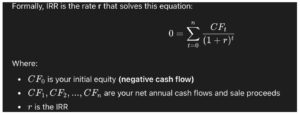
3. How IRR is actually calculated (without the heavy math)

Calculating IRR using an equation. Tim Vi Tran, SIOR, CCIM, explains internal rate of return.

Without a simple algebraic solution for most real-world deals, investors let Excel or financial calculators do the work:

From a decision standpoint, the classic rule is that a project is attractive if its IRR exceeds your minimum required return, often called your hurdle rate or cost of capital. (Investopedia)

4. A property-level IRR example (conceptual)

Imagine a Fremont industrial condo or small warehouse:

  • Equity invested (CF₀): -$2,000,000
  • Years 1–5 net cash flow (after expenses and debt service):
    • Year 1: +$80,000
    • Year 2: +$100,000
    • Year 3: +$120,000
    • Year 4: +$130,000
    • Year 5: +$140,000
  • Sale in Year 5: Net equity proceeds after closing costs: +$2,600,000

If you plug these cash flows into an IRR or XIRR function, you might see an IRR in the low-to mid-teens: meaning your equity effectively compounds at roughly that rate over the full five-year hold.

Change the timing and shape of the cash flows, and you change the IRR — sometimes dramatically.

5. Why timing matters so much for IRR

IRR rewards earlier cash flows and penalizes later ones, and this is both the strength and weakness of IRR.

Black Diamond Realty illustrates this with examples: investments with similar total profits can have very different IRRs if one produces cash earlier (leased quickly, minimal downtime) and another back-loads profits at sale. (Black Diamond Realty)

For CRE investors, that means:

  • A project that stabilizes quickly (fast lease-up, strong tenants, minimal capex surprises) often shows a higher IRR than a deal with similar profit but long lease-up or heavy renovations.
  • Two properties with the same projected total profit over 10 years can have very different IRRs based on when that profit is realized.

This is why many investors establish a “hurdle rate” — the minimum IRR they’re willing to accept given their risk tolerance and alternative opportunities. (Black Diamond Realty)

6. IRR in commercial real estate underwriting

In commercial real estate, IRR is used at several levels:

A. Property-level IRR

Sites like CommercialRealEstate.Loans show how investors use IRR to compare deals of different sizes and structures over a multi-year hold. (Commercial Real Estate Loans)

For example, you might compare:

  • A Fremont industrial building with strong tech or logistics tenants, modest leverage, and a projected IRR of 11–12%, versus
  • A secondary-market office deal, with more leasing risk but a projected IRR of 17–18%.

IRR helps you see whether the extra risk and complexity justify the higher projected return, especially if your real objective is wealth preservation and stable income.

B. Fund-level / portfolio-level IRR

At the institutional level, IRR is also calculated across entire funds or portfolios.

Fund-level IRR helps compare strategies, sponsors, and vintages, especially from the perspective of limited partners (LPs) and general partners (GPs). (Built)

At the same time, institutional investors track performance against indexes such as the NCREIF Property Index (NPI), which measures property-level returns for core institutional assets across the U.S. (NCREIF)

For a private investor or family trust, you don’t need that level of infrastructure — but the principle is the same:

IRR is one of the key metrics professional investors use to judge manager performance, strategy quality, and portfolio construction.

7. The limitations of IRR, and why you shouldn’t rely on it alone

IRR is powerful, but it is imperfect. Your underwriting will be stronger when you understand its weaknesses.

(A). Reinvestment assumption

Traditional IRR implicitly assumes that interim positive cash flows can be reinvested at the same IRR, which is rarely true in the real world. Both Investopedia and CommercialRealEstate.Loans flag this as a core limitation. (Investopedia)

(B). Multiple IRRs for unusual cash flow patterns

If your cash flow stream switches sign more than once (e.g., additional big capital injection midway through the hold), you can end up with multiple IRRs or none at all. Corporate Finance Institute and others note this issue in capital budgeting analysis. (Corporate Finance Institute)

(C). Scale and absolute dollars

IRR is percentage-based and can be misleading when comparing deals with very different sizes of equity or profit. CommercialRealEstate.Loans points out that a small investment with a very high IRR may be less meaningful than a much larger investment with a slightly lower IRR. (Commercial Real Estate Loans)

(D). Sensitivity to early cash flows

As said earlier, front-loading cash flow tends to boost IRR, which can over-reward short-term flips or aggressive assumptions about lease-up and rent growth. (Black Diamond Realty)

(E). Not a standalone decision tool

Professional investors evaluate projects with multiple metrics such as IRR, equity multiple (see 9 below), cap rate, NPV, and benchmark comparisons, instead of a single number. (Investopedia)

8. MIRR: A more realistic cousin of IRR

To address some of IRR’s weaknesses, many analysts look at MIRR (Modified Internal Rate of Return).

According to CommercialRealEstate.Loans: (Commercial Real Estate Loans)

  • MIRR assumes interim positive cash flows are reinvested at a realistic reinvestment rate, chosen by the investor.
  • It also incorporates a finance rate (your cost of capital) for negative cash flows.
  • The result is a single, more stable rate of return that often better reflects actual investor experience.

For sophisticated CRE investors, running both IRR and MIRR can highlight how sensitive your projected returns are to your reinvestment opportunities and financing costs.

9. How IRR fits with your other CRE metrics

In practice, we recommend investors view IRR as one piece of a larger toolkit:

  • Cap rate: quick view of current yield and relative pricing.
  • Cash-on-cash return: near-term income as a percentage of equity.
  • IRR / MIRR: full-period annualized return, accounting for timing.
  • Equity multiple: total cash returned ÷ total equity invested — a simple measure of how many times you get your money back, without time value assumptions. (Commercial Real Estate Loans)

Together, these metrics help you answer:

  • “Is this property priced correctly for its risk profile?”
  • “How does this deal compare to other opportunities?”
  • “Does this investment help me meet my long-term wealth and income goals?”

10. Practical tips for Fremont & Silicon Valley CRE investors using IRR

For owners, investors, and operators focused on Fremont and Silicon Valley — especially in industrial, warehouse, R&D, and related sectors — here is how we suggest using IRR:

  1. Set a realistic hurdle rate
    • Consider your opportunity cost: what could your capital earn in other conservative investments?
    • Adjust upward for asset risk, tenant quality, market volatility, and execution risk (leasing, capex, development).
  2. Stress-test assumptions, not just the IRR output
    • Run multiple scenarios for:
      • Exit cap rates (what if cap rates move 50–100 basis points against you?)
      • Rent growth and downtime between tenants
      • Interest rates and refinance risk
    • See how quickly your IRR moves when key assumptions change.
  3. Compare IRR across markets and asset types
    • A moderate IRR on a well-located Fremont industrial facility leased to strong credit tenant(s) may be preferable to a higher IRR in a weaker market with more volatility.
    • Pay attention not only to the number, but to the quality of the underlying income.
  4. Integrate IRR into 1031 Exchange planning
    • When trading out of a down-leg property, analyze the blended IRR of your potential replacement assets or portfolio.
    • Make sure your 1031 strategy aligns with your risk tolerance, timeline, and estate or tax planning — in close coordination with your CPA and legal advisors.
  5. Review IRR periodically, not just at acquisition
    • As rents reset, capex plans change, or debt terms shift, update your pro forma and see how the projected IRR evolves.
    • Use this to inform hold vs. sell decisions and to time refinancing or capital improvements.

11. How The Ivy Group approaches IRR with clients

Our role as a commercial real estate advisor is to demystify metrics like IRR and tie them back to real-world decisions:

  • We build and review cash flow models that incorporate rent rolls, operating expenses, TI/LC (tenant improvements and leasing commissions), debt, and sale assumptions.
  • We evaluate deals through multiple lenses: IRR, cap rate, equity multiple, and risk profile, instead of a single headline number.
  • For 1031 Exchange scenarios, we compare potential replacement properties and structures (single-tenant vs. multi-tenant, local vs. out-of-state, different leverage levels) using consistent underwriting.
  • We bring an owner / investor mindset — informed by SIOR and CCIM training and decades of experience — to help you understand not just “Can this hit a 15% IRR?” but “What has to go right to hit that 15%, and how comfortable are you with those assumptions?

If you are considering buying, selling, or repositioning commercial property in Fremont, Silicon Valley, or the broader Bay Area, a clear understanding of IRR is one of the tools that will help you make more confident, better-informed decisions.

👉 To learn more, you can access, for a small fee, case studies: https://theivygroup.com/courses
👉 Subscribe to The Ivy Group newsletter: https://theivygroup.substack.com/
📩 Contact The Ivy Group: https://theivygroup.com/contact-us/

About The Ivy Group

The Ivy Group specializes in commercial sales, leasing, and investment advisory across Fremont, Silicon Valley, and the Greater Bay Area. With over 100 years of combined experience and designations including SIOR and CCIM, The Ivy Group provides strategic guidance for complex transactions in commercial real estate. When you need to sell, buy, or lease, The Ivy Group is ready to help you reach your goals. Contact us with your next real estate needs.

Disclaimer

All information shared here in this article, and in all blogs, case studies, and courses offered by The Ivy Group are for general education only, not as tax, legal, or investment advice. Please seek professional advice from tax, accounting, legal, and other professionals.

Copyright © 2025 by Tim Vi Tran, SIOR, CCIM. All rights reserved.

Citation sources:

  • Investopedia – “Internal Rate of Return (IRR) Rule” https://www.investopedia.com/terms/i/internal-rate-of-return-rule.asp
  • Corporate Finance Institute – “Internal Rate of Return (IRR)” https://corporatefinanceinstitute.com/resources/valuation/internal-rate-return-irr/
  • CommercialRealEstate.Loans – “Internal Rate of Return (IRR) in Commercial Real Estate”https://www.commercialrealestate.loans/commercial-real-estate-glossary/irr-internal-rate-of-return/
  • Built Technologies – “IRR at the Commercial Real Estate Fund Level: A Guide” https://getbuilt.com/blog/irr-at-the-commercial-real-estate-fund-level-a-guide/
  • Black Diamond Realty – “The Internal Rate of Return and Measuring Real Estate Investments” https://www.blackdiamondrealty.net/company-blogs/638-2/
  • CommercialRealEstate.Loans – “MIRR: Modified Internal Rate of Return in Commercial Real Estate” https://www.commercialrealestate.loans/commercial-real-estate-glossary/mirr-modified-internal-rate-of-return/
  • NCREIF – Research (including NCREIF Property Index, NPI) https://user.ncreif.org/research/
  • The Ivy Group – “Cap Rate & NOI for Commercial Real Estate Investors in Fremont & Silicon Valley” https://theivygroup.com/commercial-real-estate-cap-rate-noi-fremont-silicon-valley-properties-tim-vi-tran/